

 Strides 2 Zero
Program Overview
STRIDES 2 Zero (State Traffic Roadway and Intersection Data Evaluation System Toward Zero Fatalities and Serious Injuries) is a statewide initiative operated by the FDOT Traffic Engineering and Operations Office. The initiative aims to eliminate traffic fatalities and serious injuries on Florida roadways through a data-driven process that provides engineering-based safety solutions and encourages technological advancements in highway safety.

Leverage Various Data Sources
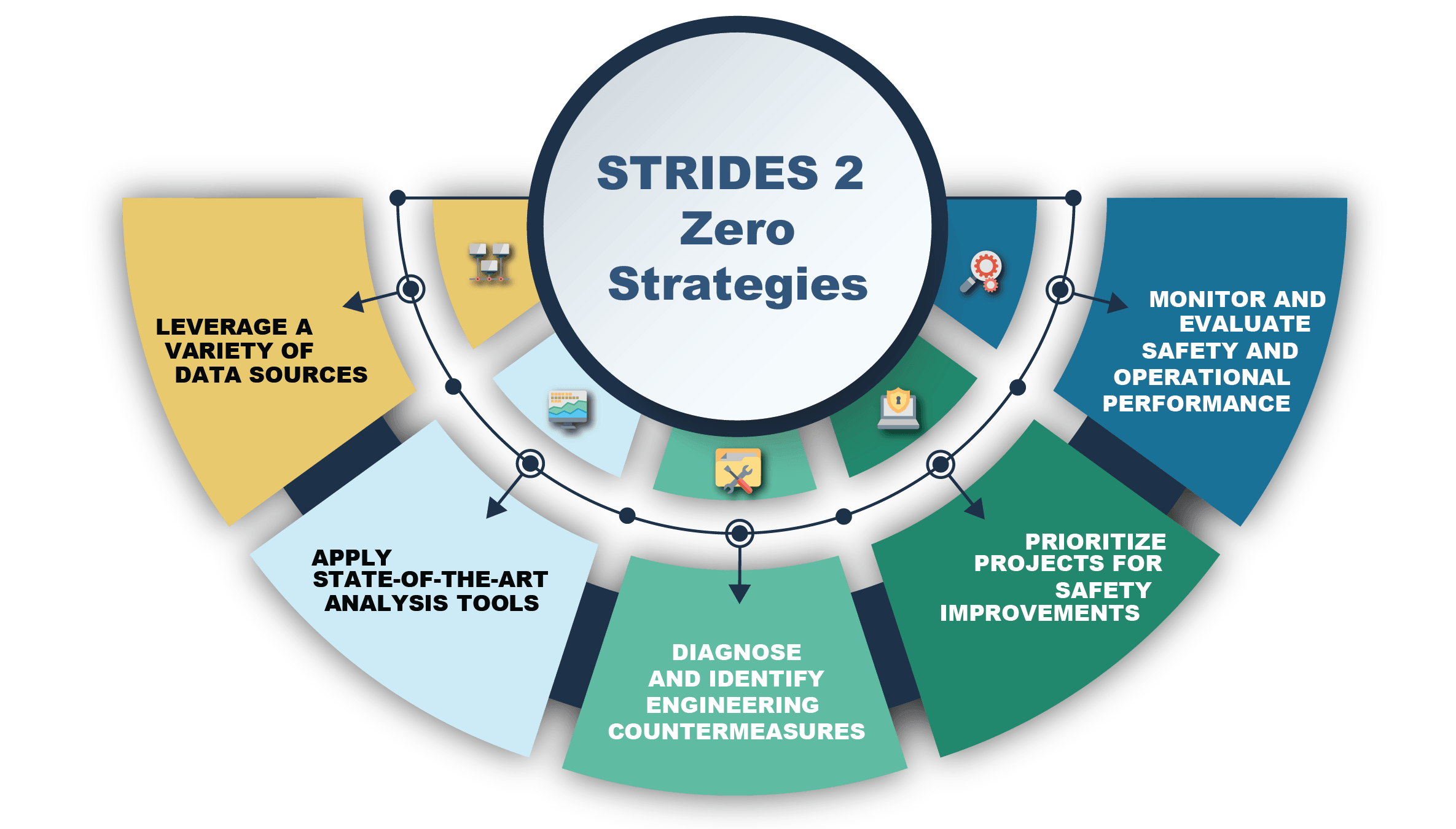
Leverage various data sources and create a repository of roadway segments, intersections, geometry, land use, traffic, and crash data for a comprehensive safety analysis.

Diagnose and Identify Engineering Countermeasures
Explore and use technological advances and research-based findings to diagnose safety concerns and identify engineering countermeasures for safety solutions.

Monitor and Evaluate Safety and Operational Performance
Monitor safety and operational performance of roadway facilities and evaluate benefits from the dollars invested.

Apply State-of-the-Art Analysis Tools
Apply state-of-the-art analytical tools and methodologies for network screening of roadway facilities and evaluating safety performance of individual sites.

Prioritize Projects for Safety Improvements
Develop enhanced tools and techniques for a reliable assessment of safety effectiveness and prioritize projects for safety improvements from a variety of project alternatives.
Focus Areas
Network Screening
As part of the STRIDES 2 Zero initiative, a network screening process has been conducted annually by developing Florida-specific Safety Performance Functions (SPFs) with recent traffic and crash data and applying the Empirical Bayes (EB)-based predictive method to determine the long-term expected safety performance of signalized intersections on the State Highway System (SHS). Find the annual network screening report below.
- 2026: Network Screening Report
- 2025: Network Screening Report
- 2024: Network Screening Report
- 2023: Network Screening Report
- 2022: Network Screening Report (Candidate Intersections, Sister Intersections)
- 2021: Network Screening Report (Candidate Intersections, Sister Intersections)
- 2020: Network Screening Report (Candidate Intersections, Sister Intersections)
Systemic Safety Analysis
The underlying principle of the systemic approach to the roadway safety management process is to identify sites with similar characteristics based on their crash potential, rather than only focusing on observed crashes. It is intended for addressing crash types that are widely dispersed across the network, which tend to be overlooked when ranking sites using a crash-history-based or site-specific safety management approach. This approach can identify opportunities to install low-cost countermeasures to sites based on crash potential to effectively reduce fatalities and serious injuries across the target facility.
STRIDES 2 Zero: Signalized Intersection Dashboards (restricted viewing)
The Power BI application shows the results of Network Screening Analysis and Systemic Safety Analysis.
Roadway Segments
Network Screening
The FDOT Roadway Safety Management Application – Segment Network Screening Analysis Dashboard is a web map application in ArcGIS (restricted viewing) that displays network screening analysis results for roadway segments on the State Highway System (SHS), excluding freeways.
The network screening process uses Florida‑specific Safety Performance Functions (SPFs) and an Empirical Bayes (EB)‑based methodology to rank SHS roadway segments by their long‑term expected safety performance. This information supports data‑driven decision‑making and helps identify locations with the greatest potential for safety improvement.
Pedestrians / Bicyclists
Network Screening
Statewide Top 30 Corridors — viewable in Internal eTraffic (restricted viewing) — provides network screening results for pedestrian and bicyclist safety. These results help identify corridors on the State Highway System (SHS) with elevated risk for vulnerable road users.