US-301 Asphalt Test Road
Overview
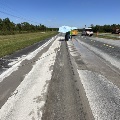
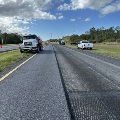
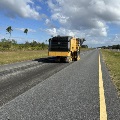
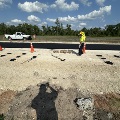
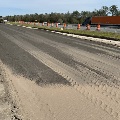
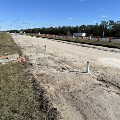
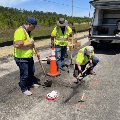
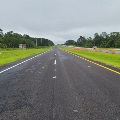
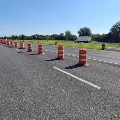
The Florida Asphalt Test Road covers 2.3 miles of experimental asphalt pavement exposed to real-world traffic conditions. This facility allows for a comprehensive in-service performance evaluation of emerging asphalt pavement technologies and innovative concepts, focusing on the interactions among factors such as traffic loading, design features, materials properties, construction practices, and environmental conditions.
The Asphalt Test Road was constructed in the existing southbound lanes of US-301 in Clay County, parallel to the Concrete Test Road and original northbound lanes. Keeping the original lanes enables traffic to be diverted as needed, ensuring that extensive performance monitoring can be carried out without disrupting the traveling public. This feature makes the test road unique, as it is the only full-scale asphalt pavement testing facility in the southeastern United States.
Experiments
The Asphalt Test Road is divided into 12 sections. Each section spans 1,000 feet and includes both travel and passing lanes. Sections 1 through 7 are focused on the base material study, featuring a standard Florida top layer structure with varying base configurations. The remaining sections, on the other hand, focus on different research topics such as reflective cracking, Superpave 5, deep lift, and FC-7 studies.
- Base Layer Experiment
- Reflective Cracking Experiment
- Superpave 5 Experiment
- Deep Lift Experiment
- FC-7 Experiment
The base layer experiment comprises seven sections with different base layer configurations. Section 1 served as the control with limerock, a typical base material in Florida. Sections 2 to 7 involved applying different base material configurations, such as 100% unstabilized Reclaimed Asphalt Pavement (RAP), cold RAP Plant mix with stabilizer, different RAP percentages mixed with limerock, and a Full Depth Reclamation (FDR) section. The primary objective is to compare structural capacity, stiffness, durability, moisture susceptibility, and long-term performance of these base systems under traffic and environmental loading relative to the standard limerock base.
The reflective cracking experiment consists of two 500-foot subsections. Longitudinal and transverse saw cuts were introduced to simulate underlying cracks before paving. One subsection was overlaid with a 1.25-inch thick crack-relief mixture incorporating a high-polymer (HP) binder, while a control mixture of the same thickness was placed on the adjacent subsection. Identical upper layers were then constructed over both. The objective is to evaluate the effectiveness of crack-relief layers in delaying crack propagation, reducing crack severity, and extending overlay service life under repeated traffic loading.
The Superpave 5 test section is constructed to assess the feasibility of implementing the Superpave 5 mix concept in Florida. Superpave 5 uses a design air void content of 5 percent instead of the current Superpave requirement of 4 percent. The primary objective is to investigate impacts on durability, rutting resistance, cracking performance, density achievement during construction, and long-term field performance under Florida traffic and climate.
Deep lift construction involves placing a 6-inch asphalt layer in one operation to improve efficiency while maintaining proper compaction and performance. Two subsections were constructed using this method. One section uses standard PG 76-22 binder (Traffic Level D), while the other uses a higher-performance HP binder (Traffic Level E). The main objective is to assess constructability and in-service performance of a 6-inch single-lift asphalt layer, including the ability to achieve uniform density throughout the full lift thickness, maintain temperature and compaction consistency during placement, and provide resistance to rutting and cracking under high-volume, heavy truck traffic.
The FC-7 section evaluates a newly-developed open-graded friction course (OGFC) intended to enhance durability relative to the conventional FC-5 mixture, which serves as the adjacent control section. The primary objectives are to compare raveling resistance, friction performance, noise characteristics, permeability, and service life, and to determine whether FC-7 can achieve improved durability without compromising functional service performance.